Wednesday, August 22, 2012

Making Stonehenge


Prototypes made of paleo fudge 

Sand to make sand dough

Mixing sand dough

Forming sarsen stones

Trilothons drying

Painting "grass"

How many do we need?

Glueing sarsen stones and bluestones

Adding lintels

Finished!

View from the keel stone

Sunday, August 19, 2012

Getting Ready for Essentials

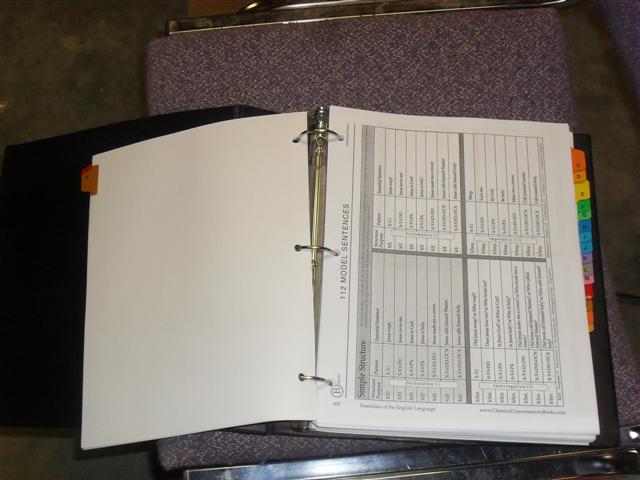
Mastery Chart Notebook-- 1 full, 10 empty, ABC dividers
It's time to get ready for Classical Conversations-- Essentials of the English Language Class. So here's how I organize my essential student.

 ESSENTIALS 

1) Essential curriculum (for me!)

2) Mastery Chart notebook-- A large notebook, divided into A through R. I place 1 copy of the full chart and 10 copies of empty charts behind each letter.

3) Quid et quo notebook-- A separate notebook with a section for 50 blank quid et quos basic pages and 25 blank quid et quo detailed pages

 4) Analytical Task Sheet notebook-- A notebook with 100 copies of blank task sheets, printed front and back
Quid et Quo-- 50 basic, 25 detailed
5) Trivium tables and moveable walls-- those cardboard things from CC


WRITING 
Writing-- Anything that needs to be written.....

1) Student Text-- I don't buy a teacher's book
2) Downloadable handbook-- Printed and spiral bound
3) Text Copies notebook-- I reuse the writing textbooks, so I don't let my kids write in it. I copy out all pages that need writing (key word outlines, etc.) and the check lists that need to be turned in with papers. I divide it out by lesson with numbered dividers.


and turn in pages, divided by lesson with # dividers


Saturday, August 18, 2012

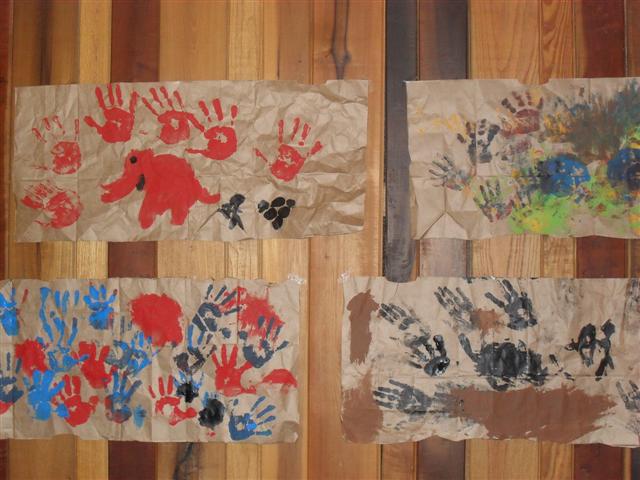
Cave Paintings

Cutting paper bags and crumpling to make walls

Paint

Just like Cheveaux

Copying techniques from the cave

Cheveaux!

Ice Age Activities


Ice Age Poster


We do "normal" stuff, too. This is penmanship. 
Ice Cream!! It's cold. Just like the Ice Age. 

Peanuts and chocolate chips!

Sunday, August 12, 2012

CC Cycle 1, Week (-2)--- Dino Diorama

Our next project was a diorama of a dinosaur habitat, complete with trees and volcanoes.


CC Cycle 1, Week (-2)-- Fossil Cookies


We made fossil cookies. I used a thick GF/CF shortbread base, to minimize spreading while baking. The kids mixed, measured, and stirred. They pressed plastic dinosaurs into the cookies to make imprints and then baked them. When cool, they dusted them with cocoa powder (okay, the concept here was to use a brush. They ended up brushing ON cocoa instead of brushing OFF dust from a fossil, but I think they got the idea). And, of course, then they ate them.


CC Cycle 1, Week (-2)-- Timelines


Chronology of the Universe Timeline
We made 3 timelines this week. The first was the chronology of the universe from the Big Bang to the present. It is made from half-length papertowels, 1 towel equals 1 billion years.


Entire Timeline
Big Bang, Dark Age, Star Formation

Formation of the Solar System

Advent of Life


Chronology of Life--1 towel = 100 million years
Formation of the Atmosphere

Cambrian Explosion

Chronology of Life, Cambrian to Quaternary, 1 towel= 40 million years


First Day of Preschool

Ivy and Laura
The school year has begun! My two little girls are going to preschool again this year. They are having a great time.
Ivy and David playing Battleship
They get lots of playtime with their brothers and sisters in the afternoon, though.


Sunday, August 5, 2012

Raven Cliff Falls, Georgia

Downy Rattlesnake Plantain (orchid)
We found a great variety of new things on this trail. The downy rattlesnake plantain, a type of orchid, was prolific and in bloom. Just gorgeous. We also saw partridge berries, wild strawberries (no berries), and black berries (still sour). There were many, many different kinds of mushrooms and in all colors, too.

I saw some type of larger wildlife-- about the size of a medium dog and gray-- could have been a large racoon, a fox, or a coyote. We also saw a very large rattlesnake. It had just shed its skin and was very vivid. Old and wise, he sat very still as we went by.

Little "sea anemones"
The trail was easy with a few patches of moderate difficulty. Its' hard to give up when a group of 70-year-old ladies come back the other way from the falls. It culminates in a large climb up a rocky hill; you can see the falls at the middle of the hill.

The 2.5 mile trail makes a total hike of 5 miles.

On our way back, the thundering clouds that we had ignored began to rain with gusto. It was very cold and miserable while it rained. The lightening was close, and a tree fell across the trail. But after we dried out, it was not so bad. The return trip went much faster than the trek in-- we didn't stop to see every plant and mushroom in the rain.

Cool Mushroom

One of the many smaller falls on the trail (Dodd's Creek)

This picture can't do justice to the color contrast--
the black log , the white water, and the red rock. It was simply beautiful

Hornet's nest

Cairn

Downy Rattlesnake Plantain


Orange mushrooms


Rock formation at the main falls
Raven Cliff Falls
Alan climbed to the very top

Sedimentary Rock

Monday, July 23, 2012

James Holmes and Autism


A great autism support site sadly posted this video this evening:


I found this article shortly thereafter.


Though Scarborough is certainly entitled to his opinion, I agree with the call for an immediate retraction of the statements made during the interview. 

Why do I feel so strongly? 

Scarborough's son is on the autism spectrum, so he is seen by many as an authority on the issue. His statement, however, is damaging and misleading. 

The very fact that Holmes did what he did shows that he was NOT acting from his autism. 

Let me explain-- bear with me. 

There are three types of empathy: cognitive, affective, and emotional.

Cognitive empathy refers to the ability to identify the needs of others and the ability to understand why they do what they do (also called perspective-taking). If I see you carrying bags of groceries, I know you need me to open the door for you. That is an identification of a need. 

Emotional empathy is the ability to feel what another person is feeling.  If you are crying because the groceries are heavy and you are sad and tired, I feel sad, too. 

Affective empathy is the empathy that moves someone to help. It's what makes me open the door.

I saw the need (cognitive empathy), I felt the need (emotional empathy), and I helped (affective empathy). 

If someone is autistic, they have difficulties with cognitive empathy-- need identification. 
Someone who is deficient in emotional empathy is psychopathic. 
Someone who is deficient in affective empathy is sociopathic. 

If somone goes on the offensive and shoots into a crowd of people with no material gain, it is because it will hurt people (which will lead to attention, etc. etc. ad nauseum). If someone knows it will hurt people, then he has identified their need to not be shot. He has identified that it will hurt them. He has identified their needs to watch a movie in safety. Someone who cannot identify those needs will not shoot them. Why shoot? There is no reason or motivation. The cognitive empathy must come first. 

If someone goes on the offensive and shoots into a crowd of people with no material gain, it is because he has identified the needs and does not react with emotional empathy. He does not feel their pain. He may not feel it at all. This is a lack of emotional empathy-- it is psychopathic. 

If someone goes on the offensive and shoots into a crowd of people with no material gain, sees people hurt and is not moved to help, but continues to fire, then there is a lack of affective empathy-- it is sociopathic. 

So was James Holmes sick? Most definitely. His behavior was both psychopathic and sociopathic. But was it autistic? No. By its very nature it cannot be autistic. This is why there is no link in the scientific literature between autism and terroristic behavior. Is he autistic? Perhaps. It is possible to be both mentally ill and autistic (John Nash, for example). But the question here is whether John Holmes' autistic traits led him to commit this act. The answer, by definition, is no. 

Autism is a lack of cognitive empathy. Not a lack of conscience. There is a difference. 

(Author's note: Yes, I understand that the subject is not so black and white and is unbelievably complicated. It will take teams of psychologists and psychiatrists years, decades, to sort through this man's brain. Yes, that makes me hesitate to post such a black and white letter. And yet it is this very complexity that makes Mr. Scarborough's initial statements so much more egregious and necessitate a response and call for retraction.)